Electrode-Water Interface Produces Giant Pockels
Effect for a ‘Liquid’ Light Modulator
TOKYO, Nov. 25, 2019 — A new type of light modulator could lead to a better understanding of how the
Pockels effect occurs in different types of materials, making it possible to more fully explore its potential in optical applications. A team of scientists at the Tokyo University of Science, led by professor Eiji Tokunaga, performed the research.
Twelve years ago, this team discovered that the Pockels effect could be observed in the top layer, also called the interfacial layer, of water when the water was in contact with an electrode. Although the Pockels coefficient was an order of magnitude greater, a highly sensitive detector was required because this effect was generated in the thin interfacial layer in water only. “It is difficult to measure the electro-optic signal using water as the medium because it occurs in only a thin layer,” Tokunaga said. “Therefore, we wanted to find a way to extract a large signal from the medium, which would not require high-sensitivity measurements and would be easier to use.”
The scientists created a setup with a transparent electrode on a glass surface in water and applied an electric field to it. Using the concept of total reflection, they created a large angle at the interface between water and electrode.
They observed that when light travels through the electrode and enters the interfacial layer (also called the electric double layer or EDL) of water, changes occur in the refractive index of both layers (water and glass) that can modify the reflected signal. Since the refractive index in the transparent electrode is larger than for both water and glass, the amount of light reflected at both ends increases, causing an enhanced Pockels effect.
“Through our technique, we observed light modulation with a maximum intensity change of 50% proportional to the applied AC voltage,” Tokunaga said.
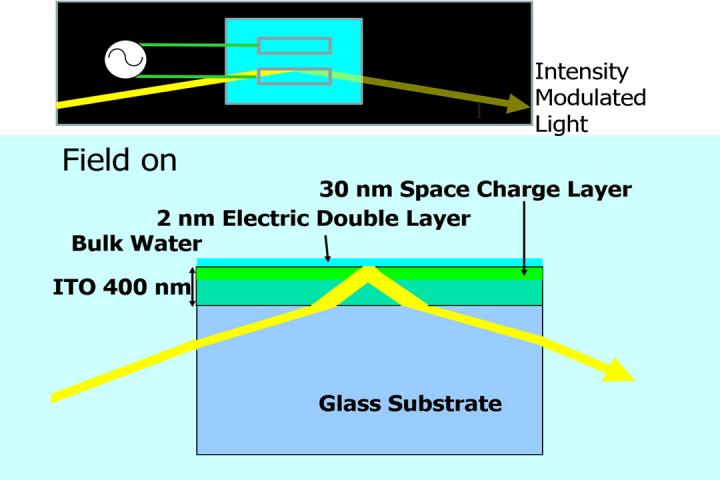
Extracting light modulation using the interfacial Pockels effect. Courtesy of professor Eiji Tokunaga,Tokyo University of Science.
When the scientists verified these results using mathematical calculations, they found that the theoretical calculations matched the experimental results. They further found that theoretically, a 100% light intensity modulation could be achieved, which also confirmed their experimental findings. “The results were surprising, but it was even more surprising when our theoretical analysis showed that they could be perfectly explained by existing optical knowledge,” Tokunaga said.
This new method of modulating light, which is low-cost and easier to detect, could serve as an attractive alternative to existing methods. Tokunaga and his team believe that by uncovering new mechanisms of light modulation, their study could open the way for more advanced research in this field. The team believes that the enhancement principle it has discovered opens up the possibility of using any interface that exists universally. “Our unique light modulation technology is unprecedented and has many possible applications because it shows a general way to extract a large Pockels signal from a universally existing interface,” Tokunaga said. “In addition, we hope that our study will give birth to a new area of research in
optics, thereby revolutionizing the field.”
The research was published in
OSA Continuum, a publication of The Optical Society (OSA) (
www.doi.org/10.1364/OSAC.2.003358).


